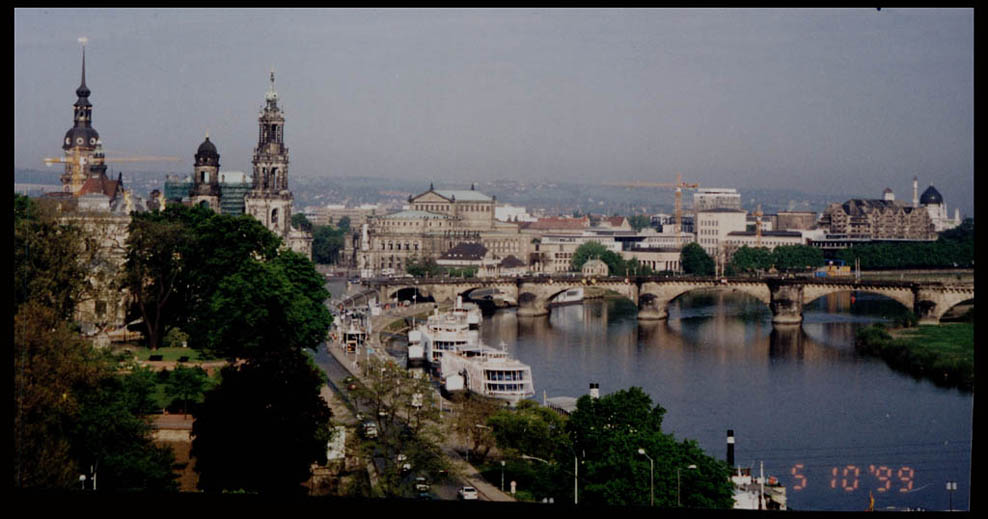
Dresden is about a two hours’ journey away by train, so on the way I had a chance to relax, do some knitting, and watch the countryside fly by. It’s a very picturesque city, but also rather depressing. It was all but flattened by the Allies (bombed mostly by British planes and not American planes, or so I’m told), and the Germans are still rather bitter about it. You hear all sorts of ridiculous stories about planes shooting at civilians and the river boiling, as well as grossly inflated death tolls. (I wrote about all that in a paper once; I guess it’s the result of some kind of post-war guilt-driven psychosis—the need to be the victims, etc.)
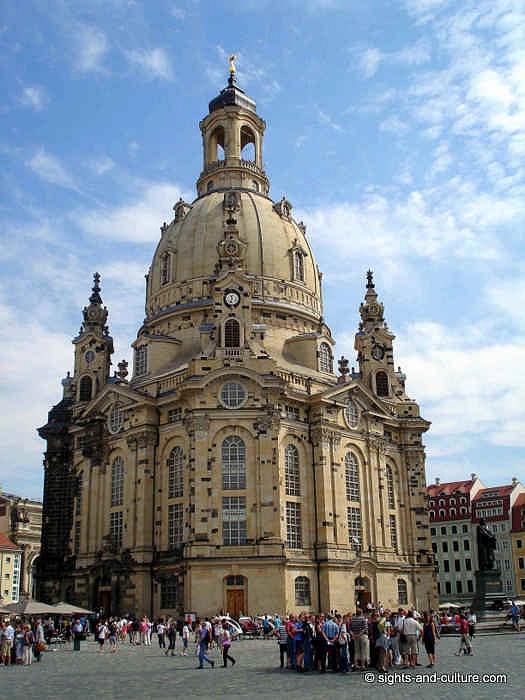
Anyway, the city hasn’t really recovered from the war. Bit by bit it’s being rebuilt (sadly, though, some of the Soviet architecture is there to stay), but it still has a long way to go. Many of the remaining buildings still have this rather macabre charred look to them. I walked from the train station to the Kreuzkirche, the town hall, and the famous Frauenkirche, freshly rebuilt. Where possible they rebuilt it using original stones. While this is nice in theory, the result is the rather odd speckled look you see here:
I was very disappointed when I reached the Albertinum and realized it was closed. The sculpture collection had been relocated to the Zwinger, but the collection of “New Masters” (a.k.a. 19th and 20th century art) was just
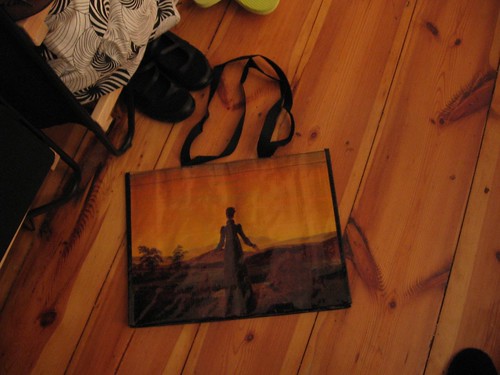
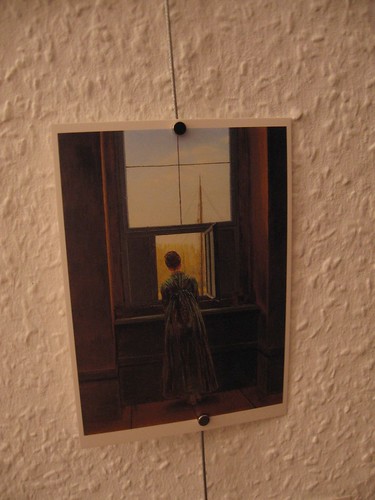
gone . A temporary exhibit will eventually be opened elsewhere in town, but for the past several months (and for several weeks to come) the art has been sitting in storage. I just can’t believe that they would put the Monets, the van Goghs, the Paul Klees, the Gustav Klimts. and the Caspar David Friedrichs in storage, as if no one would miss them. Romanticism, Impressionism, Expressionism, all gone.
This is a sampling of some of the fabulous art I didn’t get to see:
Degas

Otto Dix

Caspar David Friedrich

Van Gogh

Gustav Klimt

Monet

Carl Gustav Carus

Well, I think that’s enough bitterness, for now. I was then off to the Zwinger and an afternoon going to every museum that
was open.
My first stop was the Old Masters Gallery. The masterpiece is the Sistine Madonna by Raphael:

Quite frankly, I was disappointed. It was beautiful, yes, and perfectly balanced and composed, but it looked like it needed a good cleaning. There was an emphasis on Italian painters, and there were many pieces by Guido Reni, Titian, and Rubens. There was one measly room with a Dürer and some other recognizable
northern Renaissance painters, a rather lovely room with two Vermeers, and then many, many poorly-lit galleries filled with paintings that all looked alike by artists you (and I) have never heard of. I feel I should explain, though, that by poorly-lit, I mean lit with incredibly bright, diffused, natural light from the enormous twelve-foot windows lining the galleries. Of course, the brightness caused
massive glares, but who comes to a gallery to see the art, right?
There was, however, a fabulous exhibit of paintings by Lucas Cranach the Elder and Lucas Cranach the Younger. Apparently they were both court painters (although I can’t remember the court and am too lazy to google it). Given that one room of the exhibit contained paintings portraying Salome with the head of St. John the Baptist, David and Bathsheba, and Samson and Delilah, as well as a knife sheath featuring the myth of Phyllis and Aristotle, I assume it was a rather misogynistic court.
I should also warn anyone planning a trip to Dresden in the near future that it was filled with white-haired British tourists. They shuffled through the galleries, reading only the tags and then making inane comments like “Oh, look, here’s another Titian.” They would stare at it for a while, and then shuffle on, looking at the tags instead of the art and only stopping when they got to another name they recognized. I realize this might make me sound like a snob, but why do people go to museums who clearly have no understanding of or appreciation for art?
There was also a museum employee giving a tour to some—and by “some” I mean “two”—VIPs and frowning at anyone else who tried to listen in.
However, the day did get better from there.
My next stop was the armory. I know I may not seem like the armory type, but it was really very interesting. There was lots of silver and gold “gently used” armor, some fake horses wearing horse armor, two fake horses and two fake knights wearing real armor demonstrating jousting, plenty of swords, sabers, rapiers, and guns, but not as many cod pieces as I expected. When it all started to look the same, I left. There was also a display case comparing armor to football pads.
Then it was on to the display of scientific instruments at the Mathematics and Physics Salon. That was also rather fun—gilded and elaborately engraved scales, beautiful globes, some portraying earth and others the constellations, thermometers, microscopes, and giant lenses used to focus light and melt things such as tin, copper, and lead. I’m not sure they had a practical purpose, but I bet they were fun toys. There was also an early adding machine from Blaise Pascal; it was the first (1650) to count to 10,000,000.
After having seen the 18th century speculum at the Mathematics and Physics Salon (bonus points to anyone who can figure out what gynecology has to do with either math or physics), I thought my life was complete, but then I moved on to the main event: The Green Vault. Wow. Wow. Wow! Not very eloquent, I know, but you’d understand if you’d been there. The place was filled with the most amazing array of treasures I’ve ever seen. Things like this:

and this:

and this:

and this:

I spent almost two hours there gawking and writing effusive notes in my journal. There was at least one piece made from every imaginable material: mother of pearl, diamonds, precious stones, minerals, clay, wood, leather, gold, silver, crystal, cherry stones, nautilus shells, ivory, enamel, coral, ebony, porcelain…
The early pieces focused more on craftsmanship than on precious metals and gems (although there were plenty of those, too). There were also distinctive orientalist tendencies to the collection, with scenes and people from India, Egypt, China and the Middle East. Some of my favorite pieces were Daphne turning into a tree (see above), a set of decorative and elaborate mining equipment (see above), pieces made with nautilus shells and ostrich eggs, a carved cherry pit portraying 185 faces, a leather trout containing a set of knives, and figures made from oversized pearls:

The collection belonged to the Electors of Saxony, and it was August der Starke who collected most of the pieces in the 18th century. He’s also the monarch who developed Dresden’s porcelain collections and founded the porcelain manufacturer at Meissen. Unfortunately, only half of the museum was open. On the ground floor of the castle they have restored a Baroque vault and will display 3,000 pieces, as well as a collection of delicate Medieval and early Renaissance pieces. That part of the vault opens in mid-September and will only allow a limited number of visitors per day. I think it probably warrants a trip back to Dresden.
After viewing August der Starke’s treasures I moved on to his porcelain. Now, I should say to my skeptical readers that a collection of porcelain is much more interesting than it sounds. There was a long gallery containing Chinese and Japanese porcelain from the 17th and 18th centuries. At one point the collection contained 22,000 pieces, but only about 12,000 pieces still exist today. Thankfully, not all of them were on display. Most of it was blue-and-white, and it was very pretty, even if it did have a tendency to all look the same.
Other parts of the museum contained porcelain made in Meissen. Strangely enough, most of the early pieces looked like Chinese and Japanese porcelain; even the people they portrayed looked Asian. There were also some pieces in the ornate, Baroque “German” style. My favorite pieces were serving dishes with decorative handles in the shape of lemons, artichokes and stuffed boars’ heads.
There was also a gallery of large porcelain animal sculptures from the Meissen factories. At the time, these were the largest pieces ever made of porcelain. There were porcelain buffalo, peacocks, owls, turkeys, goats, monkeys, lions, tigers, and bears. Oh my.
My last stop was a brief visit to the sculpture collection. It was a rather odd mish-mash of pieces, with 1st-3rd century Roman sculpture standing next to 20th century pieces. I did see my second representation of Daphne of the day, as well as this sculpture:

I then walked around the roof terrace and took some photos and sat in the courtyard of the Zwinger and listened to the Glockenspiel. After that I walked back to the train station and bought a pair of shoes along the way. After that I was homeward bound.
Here are some additional pictures of how Dresdon's museums coped with the catastrophic flooding in 2002:


Labels: museums, travel